
Insight-to-actionFrom Field Reality to Coordinated Medical Affairs Action
Collecting insights is not the same as acting on them. The real test is whether external intelligence informs decisions, coordinated action and organisational learning.
By Arnas Berzanskis, Founder & Principal Adviser, Point Lumina
November 2026
Executive summary
Field Medical scientific engagement capability matters. So do appropriate pre-launch deployment, adequate resources and hands-on line-manager coaching. But capable people and better insight capture do not, on their own, establish a reliable route from external reality to organisational action.
A rise in insight volume tells leaders little about impact unless they can explain which decisions or actions changed, why they changed and what followed.
For Global, Regional and affiliate Medical Affairs leaders, Medical Excellence teams and Field Medical heads, the question is practical: does the operating model enable relevant intelligence to reach the right decision-maker and inform a proportionate response?
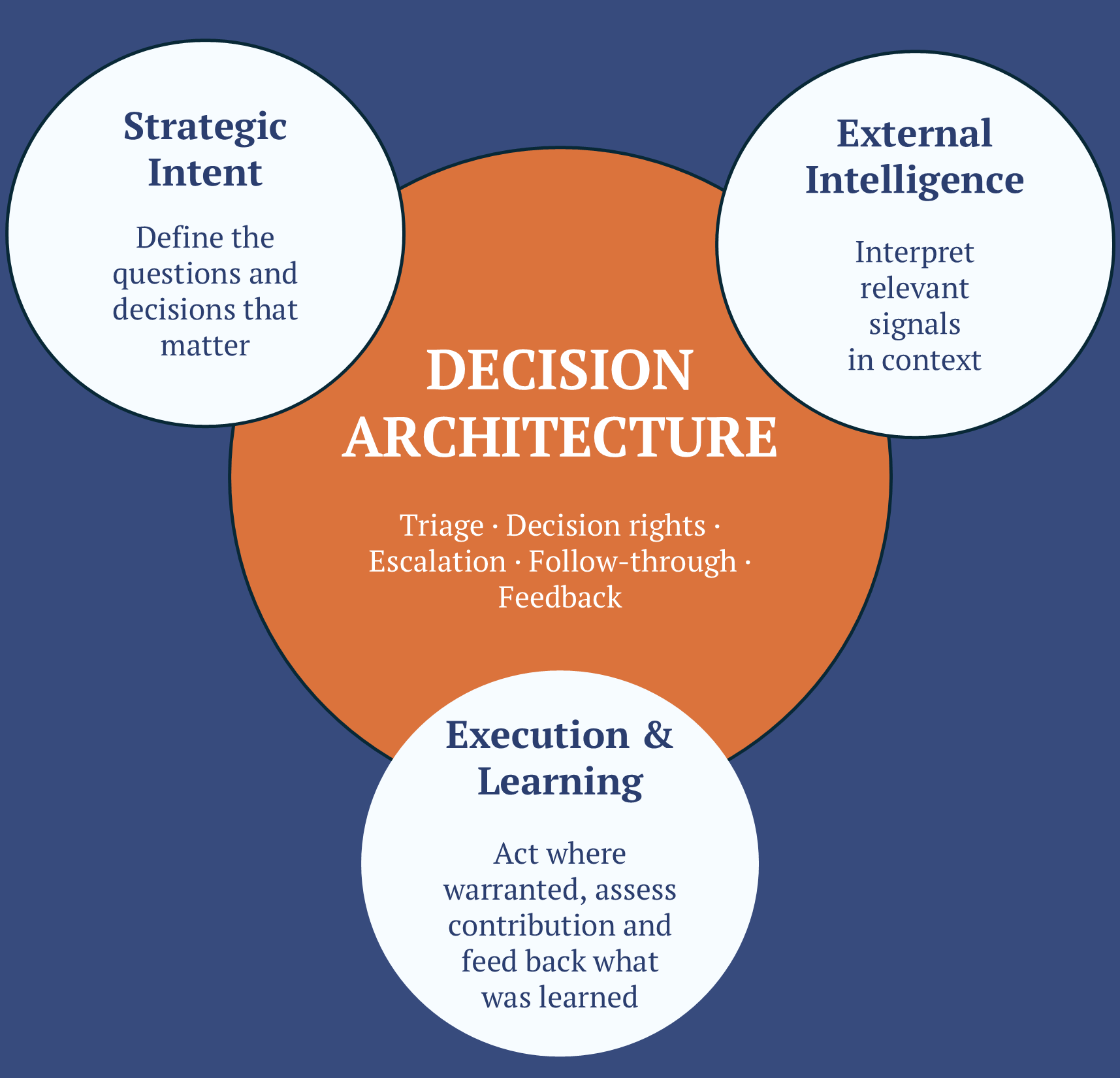
This article introduces Point Lumina’s 1+3 insight-to-action model. Decision architecture sits at its centre, supported by strategic intent, external intelligence, and execution and learning.
N.B. It is an advisory model, not a validated predictor of organisational performance.
Share the article with your team members who are responsible for insight-to-action execution.
An illustrative scenario: a decision made at the wrong level
Consider a company planning expansion into several new markets. Its launch assumptions rely heavily on epidemiological evidence from an established reference country.
Local external stakeholders describe low disease recognition and inconsistent use of diagnostic testing. Field medical feedback is translated into a request for diagnostic-test supply and escalated through the relevant grants and donations process.
The tactical request receives a negative decision because supplying tests is not in the company’s strategy. However, the wider question - whether local disease recognition, diagnostic practice and evidence gaps would undermine the launch assumptions - remains unresolved.
In this scenario, uptake is below expectations and inventory write-offs follow. These outcomes do not establish that a missed insight caused the underperformance. They show why a decision on one request (i.e. signal) should not be mistaken for resolving the underlying strategic issue.
The problem may involve several connected gaps: how the observation was interpreted, how competing launch priorities were assessed, and which owner or forum had authority to revisit the assumptions.
A decision was made. But was it the decision the organisation needed?
This hypothetical scenario examines planning and decision-making. It is not presented as a verified client case study or an evaluation of launch outcomes.
Where intelligence loses its value
Medical Affairs receives external intelligence through MSL scientific exchange, Medical Information, advisory boards, investigator interactions, publications, patient engagement and payer dialogue.
Sometimes the constraint is the quality of the input or how it’s interpreted. In other situations, relevant intelligence already exists but lacks a dependable route into decisions, coordinated action and learning. Improving one part of the system does not automatically resolve the other.
An observation is not yet an insight. An insight is not yet a decision. A decision is not yet an action, and an action is not proof of impact.
Recurrence can strengthen a signal, but it should not become the only criterion for attention. A single credible observation may warrant prompt assessment when its potential consequence is material.
An organisation can have disciplined CRM use, sophisticated dashboards and AI-assisted “insight” analysis while still struggling to establish:
• Which observations warrant further investigation or action.
• Which issues are local and which may have wider relevance.
• Who owns the decision and has authority to act.
• What should change in a plan, evidence programme or execution approach.
• Whether the response was implemented and what it contributed.
• How the originating team will receive feedback.
Recording a semi-cooked insight is one thing. Whether the organisation knows what to do with it is a completely different kettle of fish.
Point Lumina’s 1+3 Insight-to-Action model
The model has one central element - decision architecture - and three supporting elements: strategic intent, external intelligence, and execution and learning.
They are connected components, not four equal sequential stages. Execution experience should inform future questions, and new intelligence may challenge existing strategic assumptions.
At the centre: decision architecture
In my professional experience, a recurring difficulty was not simply recognising which intelligence is valuable, but agreeing on how the organisation should respond.
A pre-refined decision architecture may help you define how an issue is assessed, assigned, considered at the appropriate level, and followed through. It should clarify authority and accountability, not create another layer of meetings.
A simplified example distinguishes three routes:
• Resolve within existing authority: an account-specific or operational issue that the relevant team can address through approved processes.
• Coordinate locally across functions: a barrier requiring changes to local plans, evidence priorities or implementation, with clear functional responsibilities.
• Escalate regionally or globally: an issue that may affect wider evidence priorities, launch assumptions, resource choices or enterprise risk.
The appropriate route depends on the issue’s scope, urgency, and potential consequence (contrary to the prevalent belief that prioritises how often an issue is reported).
These routes should connect with existing decision points, including evidence planning, annual Medical planning, launch reviews and lifecycle decisions. They do not replace mandatory safety, quality or other regulated reporting processes or governance boards.
What good looks like: material issues have an accountable owner, an appropriate decision route, a documented response or rationale, and feedback to the insight-originating team or person.
Supporting element one: strategic intent
Strategic intent defines which patient, HCP, payer, and health-system, or strategic brand plan questions need attention, and which decisions would benefit from better external understanding (some companies call it “listening priorities”, but I find this term too passive and not linked to strategic intent).
Don’t confuse it with a long list of Field Medical activity objectives. Strategic intent is a shared view of the problems the organisation needs to understand and address.
Field Medical should contribute early enough to inform evidence priorities, launch readiness and local adaptation. It is too late if they only receive a plan for execution. At the same time, the organisation needs room and open-mindedness to recognise unexpected findings that challenge the existing strategy, which can sometimes be the toughest test of organisational decision-making agility in real time.
What good looks like: teams understand the decisions their scientific engagement can appropriately inform, without treating engagement as a search for confirmation of a predetermined view.
Supporting element two: external intelligence
Field Medical can and should provide continuous, contextual understanding, alongside other Medical Affairs and cross-functional sources.
For the scope of this article, I will assume that they already have a capability to turn relevant observations into decision-useful insight: what is happening, where, for whom, how credible or consistent it is, and why it may matter.
If I did not mention AI in this article, my readers will think I am old school. So, here’s my unpopular interpretation: AI can support theme identification and information retrieval, but its outputs still require human assessment of source quality, context, uncertainty, non-obvious meaning, and appropriate use.
What good looks like: teams distinguish requests, objections, observations and interpreted insights, and can explain what supports their assessment and what remains uncertain.
Supporting element three: execution and learning
The next test is whether the decision becomes a feasible response in the relevant market or institution, with ownership and resources where needed.
Not every insight requires a new programme. The response may be to adapt execution, clarify an existing plan, investigate further or document why no change is warranted.
Insight counts may remain useful operational measures. They should not be treated as evidence of impact on their own. Follow the connection between:
Signal → Insight → Decision → Action → Assessed contribution
This is just a review lens, not a requirement that every observation must generate an action or a claim of causation. I hope people are not following the concepts outlined in this article religiously…
What good looks like: teams understand what changed, why it changed - or did not - and what they should investigate or listen for next.
Four questions to examine your decision architecture
Point Lumina’s Decision Architecture Test (PL-DAT) is a four-question discussion aid. It is not a validated diagnostic instrument or a substitute for a detailed operating-model review.
1. Do Field Medical teams understand which strategic questions and decisions their external engagement can appropriately inform?
2. Can we distinguish individual observations, recurring signals and credible high-consequence exceptions, and connect them with a relevant evidence or execution priority?
3. Is there a clear owner, decision forum and escalation route for material issues, and can we explain the response and follow-through?
4. Can global, regional and local teams adapt execution to healthcare-system realities while remaining aligned on strategic intent, scientific standards and governance?
An unclear answer does not prove that the operating model is defective. It identifies an area worth investigating before assuming that additional training, CRM functionality or insight volume will resolve the problem.
Revisit the launch and address the underlying question
A more useful response to the launch scenario above would not start by finding another route to provide diagnostic tests (e.g., a patient support programme, a healthcare support programme, etc., depending on your company’s appetite for creative governance). It would first separate the tactical request from the strategic uncertainty:
• Signal: local stakeholders report low disease recognition and inconsistent diagnostic practice.
• Insight to test: the reference-market evidence and assumptions may not sufficiently describe local need or implementation conditions. Limited diagnosis alone does not establish the local disease burden or invalidate the reference data.
• Decision: the appropriate local/regional/global Medical and evidence owners agree what needs investigation, what existing evidence can answer, and whether the plan requires adaptation.
• Action: assess the need for local analysis, epidemiological modelling, additional research or an appropriate awareness or implementation response, with agreed ownership, resources and governance.
• Assessment: examine whether the response resolved the relevant uncertainty or informed a subsequent evidence, access or implementation decision.
Any modelling or research needs suitable inputs and a design fit for its purpose. Neither commissioning a study nor observing later product uptake establishes that Medical Affairs caused the change.
N.B. This is an illustrative alternative decision route, not a claim that a particular intervention would have rescued the launch.
From insight collection to accountable action
Field Medical capability and decision architecture reinforce one another. Better interpretation makes intelligence more useful; clear decision routes make it more likely to receive an appropriate response.
The leadership question should therefore go beyond “How many insights did we collect?”
Which decisions and actions changed because we understood external reality better, and what evidence supports the contribution we claim we have made?
Start with one material issue and examine what happened: how it was interpreted, who owned the decision, what response followed and what the organisation learned. The findings may justify a focused change or reveal a wider operating-model constraint.
What is limiting your organisation’s Insight-to-Action?
Point Lumina’s Insight-to-Action Operating Model Review helps leaders distinguish isolated capability and implementation issues from structural barriers, and establish a prioritised basis for improving decisions and execution.