
Medical education impactBeyond Completion Rates: A Pharma Framework for Proportionate Medical Education Impact
How operating-model decisions connect educational ambition, investment and credible evidence of impact.
By Arnas Berzanskis, Founder & Principal Adviser, Point Lumina
October 2026
Executive summary
Medical education should start with a defined educational or clinical-practice gap, not a preferred activity format or KPI dashboard. The intended change, intervention, implementation support and impact-measurement plan should align.
Reach and completion remain useful measures of delivery. On their own, they do not demonstrate learning or changes in clinical practice. Equally, patient outcomes should not become the default expectation for every education programme.
For Medical Affairs leaders, this is as much an operating-model question as a measurement question: how do we define the ambition, commit resources, secure data, support local delivery and act on the findings?
This article focuses on company-led, non-promotional medical education. Independent medical education and promotional activities serve different purposes and have different governance and decision rights. From an operating-model perspective, they remain important related considerations, which we will address in other articles.
What are we getting from our investment in company-led medical education?
How many times has a General Manager asked you: “What is the ROI of medical education?”
It is a reasonable question and one I frequently hear from commercial leaders. But before answering, we need to clarify whether the question concerns educational outcomes, value for money, or financial return.
A more useful starting question is:
“What outcome did the company-led medical education programme deliver?”
More specifically:
Did the intended healthcare professional (HCP) cohort learn, retain knowledge, develop competence or change aspects of practice?
Were the benefits proportionate to the resources used and reasonable alternatives?
A clear answer should follow a short, scope-defined, leadership-ready thread:
Prespecified gap → Investment and effort → Proportionate impact
If that thread is difficult to explain, it is worth examining whether the investment, intended outcomes, delivery model and measurement requirements fit together. Difficulty articulating the answer does not establish a mismatch, but it is a reason to investigate.
Why demonstrating medical education impact is difficult.
Published sources point to an implementation gap rather than simply a lack of ambition.
EPG Health research reported in PMLiVE in 2024 found that 63% of pharma respondents saw demonstrating behavioural impact and outcomes as a major challenge. Fewer than 20% assessed whether digital HCP engagement met educational needs or influenced clinical practice. These findings concern HCP engagement broadly, not exclusively company-led medical education. (1)
Veeva describes a related disconnect in field medical: 44% of surveyed leaders prioritised clinical-practice-change indicators, while separate observations of 17 major biopharma companies suggested that approximately 5% used such measures. These are different evidence sets, not a paired comparison of the same companies. (2)
IQVIA identifies strategic alignment, data quality, integration and governance as hurdles to meaningful Medical Affairs measurement. Its discussion reinforces the need to connect objectives, implementation and evidence of impact—not simply add more metrics. (3)
Illustrative scenarios: when ambition, delivery and measurement do not align.
The following scenarios are hypothetical illustrations, not client case studies or evidence of measured results from applying the framework. Budgets, activity volumes and audience targets are illustrative; they are not benchmarks for programme effectiveness.
Scenario A: narrow the outcome commitment—or strengthen the programme
The plan
A small affiliate proposes ten short, pre-recorded webinars led by local clinical experts, using approximately 5% of its annual Medical Affairs spend. Distribution relies on the company’s non-promotional website and Medical Science Liaison (MSL) communications. The audience target exceeds 5,000 GPs.
Proposed measures include registrations, completion, satisfaction, knowledge retention at 90 days, practice change assessed through MSL interviews, and guideline adoption tracked through an accessible database.
The critique
Neither the budget percentage nor the number of webinars establishes whether the programme is proportionate. The questions are whether the target attendee number is credible, the HCP specialty is appropriate, how the intervention is expected to change practice and whether the proposed data can assess that change in the intended cohort.
MSL interviews may provide useful reports of practice, but they should not be labelled direct observation. Assessing knowledge across an audience of 5,000 GPs would also require a feasible sampling and follow-up approach rather than relying on MSL reach alone. An accessible database is not automatically suitable: its population, variables and timing must fit the intended assessment. Delayed knowledge retention also requires a realistic follow-up plan.
The options
The Country Medical Director has two legitimate routes:
Retain a focused educational intervention and narrow the outcome commitment to feasible measures of cohort engagement and learning.
If a practice-change objective is strongly justified, strengthen the intervention, implementation support, evaluation design and resources to match it.
Scenario B: align the investment with the evidence need
The plan
A global therapy-area team commissions a £1.2 million, 12-month accredited medical education programme across several strategically important markets. The therapy area is critical to the company, and the programme combines expert-led webinars, interactive clinical cases and materials for locally delivered workshops.
Global allocates investment to educational content and delivery and measures success through participation, completion and knowledge gain. Local operating companies, however, need evidence of changes in diagnostic and treatment practice to support discussions with payers about funding. They envisage a comparative real-world evidence (RWE) approach—for example, comparing an education-supported implementation approach with usual practice.
The programme is developed without jointly agreeing these objectives, the comparative evaluation design or how resources will be allocated among education, local implementation and evidence generation.
The critique
The problem is not simply that the programme is expensive or that affiliates were insufficiently involved. The budget sits in an educational delivery bucket, while a strategically important local need—generating decision-relevant evidence—remains unfunded.
Global and local teams are pursuing different outcomes. Global plans to demonstrate knowledge gain; local teams need to understand whether an education-supported approach changes clinical practice and produces evidence relevant to diagnostic and treatment funding. Participation and knowledge scores cannot answer that question.
Because the programme targets only several key markets, the teams should have jointly assessed those markets’ evidence needs before committing the investment. This would have clarified which diagnostic and treatment barriers education could address, which required other interventions, and whether a comparative RWE study could inform payer discussions.
A comparison alone would not establish causation or guarantee that the evidence meets payer requirements. The study population, outcomes, comparator, data quality and evaluation design would need to fit the intended decision.
The options
The Global Therapy Area Lead and local Medical Directors have two legitimate routes:
Retain a knowledge-focused education programme, confirm its local value and narrow its scope and investment accordingly. Address the comparative RWE requirement through a separately funded, appropriately governed evidence plan.
Redesign the investment as a coordinated education, implementation and evidence-generation programme in the priority markets. Jointly agree the local decision needs, diagnostic and treatment practice outcomes, intervention and comparator, data access, evaluation design and ownership. Explicitly allocate resources across educational delivery, local implementation and RWE generation, with appropriate scientific and governance separation.
The decision is not simply whether affiliates should fund the global programme. It is whether global and local teams can agree what the investment needs to achieve and put the resources in the right places to deliver and assess it.
Three practical questions before commissioning a medical education programme.
For Heads of Medical Affairs and Medical Excellence, Medical Directors, and global, regional and local therapy-area and brand leaders accountable for medical education investment and implementation, three questions provide a practical starting point:
Which outcome ambition is appropriate, and why: knowledge, competence, practice change or patient outcomes?
Which tools and data sources can credibly assess the intended change in the intended cohort, and do you have access to them?
What supports the judgement about how much of the gap this intervention could plausibly address: a needs assessment, relevant evidence, clinical insight, a delivery partner’s proposal, explicit programme logic or the company’s proprietary framework?
Before commissioning the medical education programme, the organisation needs to agree on the intervention, desired change, data access, local implementation and budget horizon.
Point Lumina’s Proportionate Impact Framework
The Proportionate Impact Framework for Medical Education is Point Lumina’s simple visual planning aid. It supports a first-pass assessment of whether the intended change, intervention scope, implementation support and proposed impact measures fit together.
It is an advisory framework, not a validated predictive instrument, an impact evaluation or a method for calculating financial ROI.
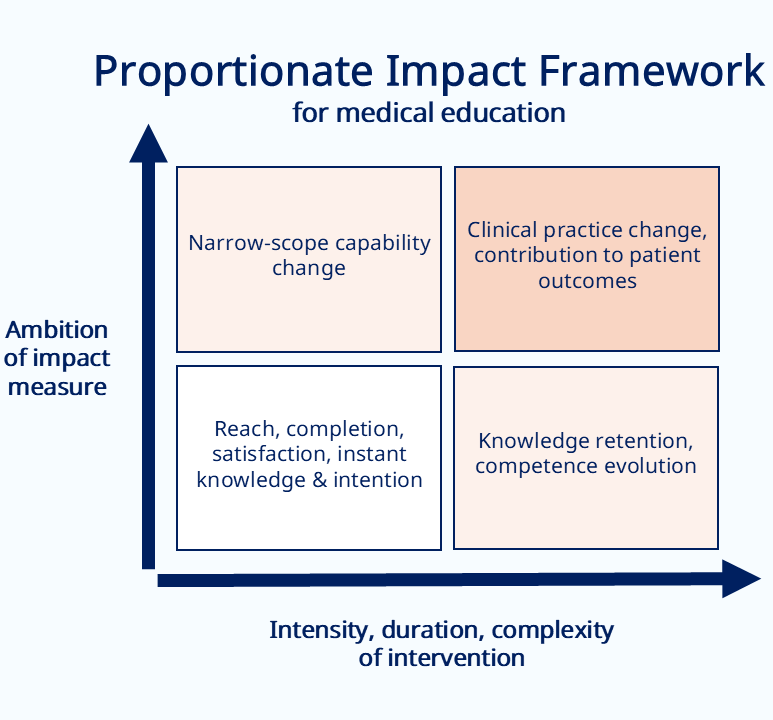
*Illustrative measurement options. Not predicted results. Programme intensity does not determine impact. The proposed measures must also fit the educational gap, implementation conditions and available evidence.
Read the grid as a discussion aid, not a score or a ladder. No quadrant is inherently right or wrong. A short, well-targeted intervention may address a specific, narrow-scope practice barrier; a substantial programme may legitimately focus on substantive learning. Duration, budget and accreditation do not determine the outcome on their own.
Strength of evidence is a separate question from outcome ambition. A rigorous longitudinal capability assessment may support a firmer conclusion than a poorly controlled patient-outcome analysis. At every position in the grid, examine baseline or comparator availability, assessment validity, follow-up, cohort coverage, data access and ownership.
Include patient outcomes only when the intervention logic, available data, follow-up and evaluation design justify the proposed claim—not simply because patient benefit is the ultimate purpose of Medical Affairs.
From programme planning to portfolio decisions.
Apply the framework across several programmes and a different question emerges: where is stronger impact assessment worth the investment, where does delivery need redesign, and where should expectations be reduced?
The answer depends on the decision at stake, the importance of the gap, local readiness and the feasibility of obtaining useful evidence of impact. A focused intervention can be good value when it achieves a bounded objective. A substantial programme may be justified when change requires reinforcement and sustained local support. Neither budget size nor activity volume substitutes for credible programme logic.
Start with the smallest change that resolves the material gap. Sometimes that means a clearer objective or an accountable owner. Sometimes it means additional investment or deciding not to proceed.
Point Lumina’s Medical Education Impact Review uses the Proportionate Impact Framework as an entry point to examine intended change, intervention design, measurement feasibility, local implementation and decision ownership. The output is a prioritised set of recommendations on what to measure, redesign, sustain or stop.
Before the next planning cycle, ask which programmes have an agreed outcome ambition, a feasible measurement plan and funded follow-through—and which need a planning decision before commissioning more activity.
Sources and scope notes
These sources provide context on HCP engagement and Medical Affairs measurement. They do not validate Point Lumina’s framework. The framework, planning recommendations and hypothetical scenarios are the author’s advisory contributions.
1. EPG Health, reported in PMLiVE, 28 February 2024. Valuable research insights to steer pharma’s HCP engagement impact. Scope: digital HCP engagement, not exclusively medical education. https://pmlive.com/pharma_thought_leadership/valuable-research-insights-to-steer-pharmas-hcp-engagement-impact/
2. Veeva. Measuring the Impact of Medical Affairs, Part 1: A Data-Driven, Modular Approach. White paper drawing on a November 2023 survey and separate observations of 17 companies. Scope: field medical. https://www.veeva.com/eu/wp-content/uploads/2024/03/Veev_Demonstrating-the-Value-of-Medical-Affairs_EU-1.pdf
3. IQVIA, 6 June 2025. Navigating the Complexities of Medical Affairs Impact Metrics. Provider-authored discussion of measurement strategy and implementation challenges. https://www.iqvia.com/locations/united-states/blogs/2025/06/navigating-the-complexities-of-medical-affairs-impact-metrics