
Medical Education ImpactProportionate Impact Framework (PIF)
Assess whether your medical education programme’s intended change, investment and effort, and proposed outcome measures fit together.
What is the Proportionate Impact Framework?
Point Lumina’s Proportionate Impact Framework (PIF) is a starting-point visual aid that helps teams consider the relationship between the intervention they are planning and the level of change they want to demonstrate. It makes potential mismatches visible and provides a starting point for deciding whether to adjust the programme, the measurement ambition or both.
Who is this framework for?
It is designed for Medical Affairs and Medical Excellence leaders, Medical Directors, and therapy-area teams responsible for medical education investment and implementation.
How to read the grid
The horizontal axis considers the intervention’s intensity, duration and complexity, from a focused activity to a more sustained, multi-component programme.
The vertical axis considers the ambition of what you want to demonstrate. The quadrants illustrate different measurement possibilities, from participation and immediate learning to retained knowledge, capability development, clinical-practice change and contributions to patient outcomes.
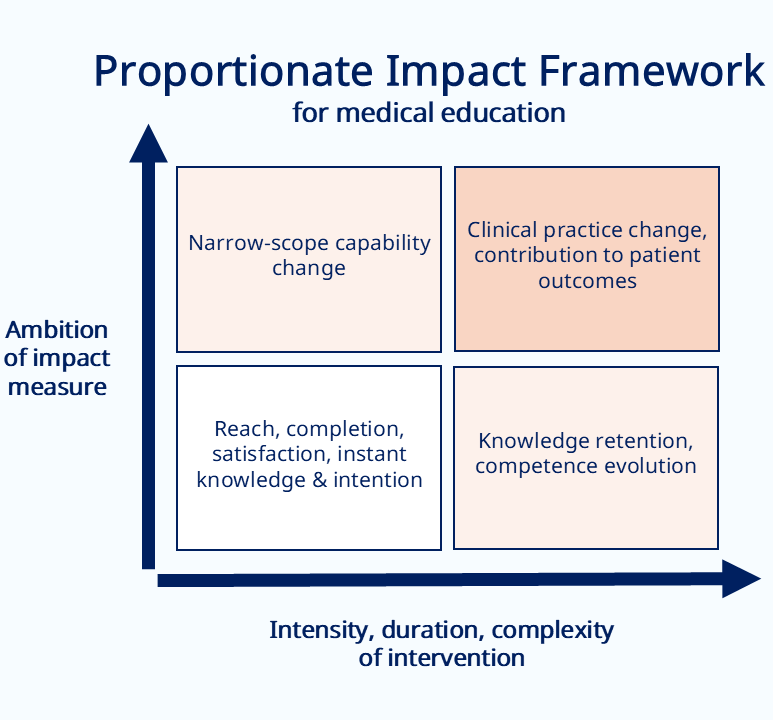
Illustrative measurement options. Not predicted results. Programme intensity does not determine impact. Proposed measures must also fit the educational gap, implementation conditions and available evidence.
PIF discussion guide
Use the grid to discuss the fit between the programme and its proposed measures:
A focused intervention may reasonably assess immediate learning or a narrowly defined capability change, depending on its design and assessment.
A sustained programme may appropriately focus on knowledge retention and competence development without promising patient outcomes.
Practice change and patient-outcome assessment require a credible intervention mechanism, suitable data and an evaluation approach that supports the proposed claim.
What the framework does and does not do.
PIF is an advisory planning aid. It does not predict clinical outcomes, measure achieved impact, establish causation or calculate financial ROI.
Completion and satisfaction remain useful delivery measures, but do not establish learning or practice change. Intention to change is not the same as reported or observed behaviour.
Education, guidelines, access, service capacity, and other factors may influence clinical practice and patient outcomes in combination. Conclusions should reflect what the assessment can establish, including uncertainty and limits on attribution.
The grid is not a ladder on which every programme should aim for the upper-right corner. Nor does it imply that every measure belongs exclusively in one quadrant. A programme may use measures spanning several quadrants, provided each serves a clear purpose.
Scientific validity and non-promotional governance remain essential. Using the framework does not replace applicable law, codes, accreditation requirements or company policies.
See the framework in context.
Explore two illustrative scenarios showing how different mismatches can require different decisions, from narrowing an outcome claim to strengthening the programme and its operating model.